Why Uber may still be worth $100 billion-plus even after its embarrassing IPO
2:35
10:18
Uber investors are betting on the 'simple core of the business model'
So what are investors betting on here?
The long-term can’t get here quick enough for Uber (UBER) CEO Dara Khosrowshahi after its hotly anticipated IPO got relegated to the embarrassing column amid a terrible first day of trading Friday on the New York Stock Exchange.
In hindsight, ousted founder Travis Kalanick’s decision to reportedly watch some of the early trading with friends and current/former Uber employees over coffee around the block of the NYSE was a wise one — who would want to see a day one bloodbath of a company once believed to be worth $120 billion plus?
What happened
With President Donald Trump dropping trade war bombs on the heads of Chinese officials via Twitter and rival Lyft (LYFT) continuing to be a disaster, post its late March IPO, Uber’s IPO day for lack of better words stunk.
The ride-hailing business priced its stock at $45 a share on Thursday, giving the company a valuation of $82.4 billion. Uber began trading on Friday morning at about $42 a share. By the time the market closed, Uber’s stock had nosedived 7.6% from its IPO price to $41.57.
“We believe Uber is off to a choppy trade on the heels of the Lyft train wreck out of the gates and general investor nervousness on the U.S./China [trade war], risk-off worries in this market,” Uber bull and Wedbush Securities analyst Dan Ives tells Yahoo Finance.
Ives says many investors he spoke to were hesitant to buy Uber out of the box given the beating Lyft has taken since its IPO. Investors are waiting to see the stock settle before accumulating significant positions, according to Ives.
It will be interesting to see when Uber’s stock does decide to settle.
The company isn’t expected to be profitable anytime soon. Concerns continue to mount on Uber’s ability to sustain its independent contractor model for its drivers. And the business arguably has no moat around it — capital is simply being invested to drive quarterly market share in the ride-hailing battle with the smaller Lyft.
Wall Street reacts
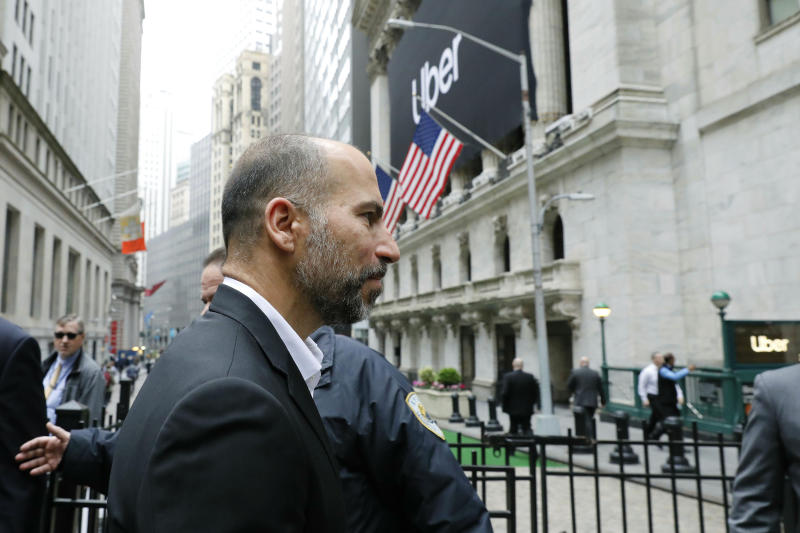
Uber CEO Dara Khosrowshahi arrives at the New York Stock Exchange for his company's initial public offering, Friday, May 10, 2019. (AP Photo/Mark Lennihan)
Wall Street analysts mostly came out bullish on Uber ahead of its IPO. It’s unlikely this influential crowd will shift their views due to what may be a sluggish first few days of trading. But if the stock’s weakness does persist into June in the lead-up to Uber’s first earnings report, the analyst community may have no other choice but to change their tune.
For now, a bull such as Ives is staying the course.
“We are not worried the stock is turbulent today on its first day of pricing and we continue to believe on a sum of the parts valuation this stock is worth a $100 billion+ and we would be buyers here despite the choppy tech tape and general market worries,” Ives contends. “We believe this weakness in shares of Uber will be not be elongated as the core value of this franchise is markedly higher than these levels in our opinion.”
Ives believes that Uber is not unlike Amazon or Facebook — a true number one player in an industry it’s pioneering. That, Ives reasons, is why Uber’s long-term valuation is probably higher and one day of soft bids for the stock is nothing.
Others on the Street are unsure.
“The message from Wall Street is clear that investor appetite for ride hailing firms is not what the hype expected it to be,” says Jasper Lawler, head of research at London Capital Group.
Even Lyft management proclaiming on its first earnings call with analysts this month that 2019 would mark peak losses didn’t jump-start the sagging stock. Given Lyft’s inability to convince people to jump into the stock 23% lower from IPO day, it’s hard to see how Uber management wins over a chorus of early bears.
Chinese Woman’s Secret Arrest Hints at Wider Probe
Chinese Woman’s Secret Arrest Hints at Wider Probe
(Bloomberg) -- U.S. authorities were sitting on a sensitive secret last fall when Canada detained a top Huawei Technologies Co. executive on alleged U.S. sanctions violations.
Two months earlier, the U.S. had arrested another Chinese national on similar suspicions and was holding her at a grim jail in Washington, D.C. An employee of an unidentified Chinese technology company, she had been nabbed on vacation in California.
The employee, Liu “Willow” Yang, 29, ultimately pleaded guilty and went back to China. But unlike the legal spectacle in Canada over the extradition and prosecution of Huawei’s chief financial officer, the Yang matter remains largely under wraps in the U.S.
Yang had at least one co-conspirator, according to newly unsealed portions of the case and court transcripts reviewed by Bloomberg News, suggesting that the U.S. may be pursuing a wider crackdown on sanctions violations than was previously known.
The prosecution of Yang is the third known instance of the U.S. going after Chinese technology companies or their employees for trading with Iran and other countries blacklisted by the U.S. on terrorism, national security or human rights grounds. Besides Huawei, ZTE Corp. was forced to pay $1.2 billion to U.S. authorities to settle allegations that it violated U.S. laws restricting sales to Iran and North Korea.
The Chinese technology company that employed Yang wasn’t disclosed in court records, and it wasn’t accused of wrongdoing. It was unclear whether the U.S. technology sold to Iran had a potential military application, which would heighten U.S. ire.
“I’m sure there will be widespread publicity about this case,” Liu’s lawyer, Melissa Madrigal, said during her sentencing hearing. “I’m sure Your Honor has seen the Huawei case and the publicity that case has received.”
A representative of the Chinese embassy in Washington and a spokesman for the U.S. attorney’s office in Washington declined to comment.
Sealed Case
Typically, criminal investigations become public at the point when people are charged or after cooperators have pleaded guilty. The Yang case, by contrast, was fully sealed until last month, and large portions are still hidden from public view, including basic court records such as the one outlining the evidence and allegations against Yang and the record of her guilty plea.
“A likely explanation is that this material is under seal because the government believes its public disclosure now would harm an ongoing investigation,” said David Laufman, a partner at Wiggin and Dana who previously oversaw export control and sanctions enforcement at the Justice Department.
In a Washington courtroom where U.S. District Judge Tanya S. Chutkan sometimes covered the windows, Yang admitted to helping ship more than $870,000 worth of American electronics to Iran over a six-year period.
The judge went easy on Yang, sentencing her to time served. Chutkan cited Yang’s arrest while on vacation, the poor conditions at the jail and the impact on her family -- including two young children, one of them an infant suffering from a brain tumor at the time of Yang’s detention.
Strained Relations
The U.S. sanctions investigations are unspooling at a time of heightened sensitivity in relations between the two world powers. Trade negotiations are hanging in the balance as the Trump administration continues to try to economically and politically isolate Iran, a top Chinese trading partner.
On Friday, President Donald Trump raised tariffs on $200 billion in goods from China as he sought to extract concessions in trade negotiations taking place in Washington between U.S. officials and China’s top trade envoy, Liu He.
As the U.S. has sought to choke off a key source of Iranian state revenue -- oil exports -- China has resisted American demands to reduce purchases of oil from Iran, a major supplier for the country.
“Historically there’s been a real reluctance to pursue either penalty enforcement or sanctions designations against Chinese companies. Now I think you’re seeing a much greater willingness to do that,” said Carlton Greene, a Crowell & Morning partner who previously directed sanctions investigations at the Treasury Department’s Office of Foreign Assets Control.
More Targets
In the highest-profile sanctions case, the CTO of Huawei, Meng Wanzhou, was detained in Canada in December on a U.S. warrant after authorities concluded she had played an intimate role in Huawei’s Iran business, including misleading banks and others about the extent of it.
The company, its U.S. subsidiary and Meng were indicted by federal prosecutors in Brooklyn in January, and the U.S. has blocked government use of Huawei technology, saying it could provide a backdoor for Chinese espionage. Huawei has vigorously denied the accusations.
Meng’s lawyers argued in court on Wednesday that her constitutional rights were violated when she was detained at the Vancouver airport before her arrest at the request of U.S. authorities. They also plan to question whether the U.S. bank-fraud charges against her constitute a crime in Canada.
As for Yang, much about her activities remain unknown. After her arrest in California, she was quickly transferred to Washington, where she acknowledged her role in the scheme and agreed to plead guilty, according to court records.
A Co-Conspirator
The records indicate she began working with a co-conspirator whom she had met through her employment, and took on additional duties to make extra money. The duties involved organizing transshipments -- routing deliveries through intermediate destinations, a technique often used to hide the origin or destination of illicit transactions. Even after she became aware that the deals violated U.S. sanctions laws, she continued to do it anyway, the filings say.
“Liu didn’t realize or appreciate the seriousness of her actions or the risk she was taking by facilitating these transactions,” Madrigal, Yang’s lawyer, said during her sentencing hearing. Liu earned $25,000 from the trades over the course of the scheme, which she agreed to forfeit to U.S. authorities.
Though she could have received five years in prison, federal prosecutors from the national security unit of the U.S. attorney’s office in Washington recommended a lighter sentence because she “assisted authorities in the investigation and prosecution of this matter,” Chutkan, the judge, said during her sentencing hearing.
Prosecutors and defense lawyers filed a joint motion seeking an order to have Yang deported home as soon as her sentence was imposed, to which the judge agreed -- noting Yang was “not the mastermind of the conspiracy.”
(Adds comment in 10th paragraph.)
To contact the reporters on this story: Christian Berthelsen in New York at cberthelsen1@bloomberg.net;Tom Schoenberg in Washington at tschoenberg@bloomberg.net
To contact the editors responsible for this story: Heather Smith at hsmith26@bloomberg.net, David S. Joachim, Jeffrey D Grocott